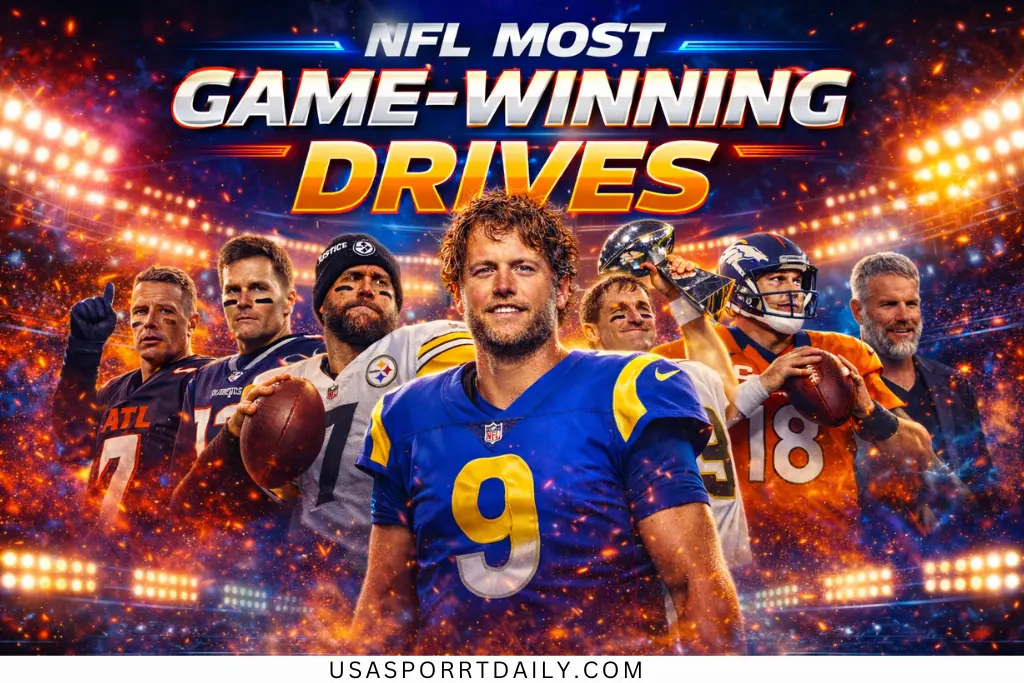
In the National Football League (NFL), greatness is often measured not just by touchdowns, passing yards, or MVP awards—but by how a quarterback performs when the game is on the line.
When the clock is ticking down and a team needs a final scoring drive to win or take the lead, elite quarterbacks rise above the pressure.
This moment is where game-winning drives (GWDs) become a defining statistic. A game-winning drive occurs when a quarterback leads their team to a score that puts them ahead in the fourth quarter or overtime for the final time in the game.
The list of quarterbacks with the most game-winning drives in NFL history is filled with legendary names who built their reputations on clutch performances.
From Tom Brady’s historic comebacks to Peyton Manning’s precision leadership, these quarterbacks proved they could deliver when everything was on the line.
In this article, we’ll explore the quarterbacks with the most game-winning drives in NFL history, analyze what makes them so clutch, and examine why this stat remains one of football’s most exciting measures of quarterback greatness.
What Is a Game-Winning Drive in the NFL?
Before diving into the rankings, it’s important to understand what qualifies as a game-winning drive.
A game-winning drive is credited to a quarterback when they lead an offensive drive that:
- Occurs in the 4th quarter or overtime
- Results in the go-ahead score
- Leaves no opportunity for the opponent to regain the lead
This score can be a touchdown, field goal, or even a safety. The key element is that the drive directly results in the winning points.
Game-winning drives are highly valued because they highlight:
- Leadership under pressure
- Decision-making in critical moments
- Offensive execution late in games
In other words, this stat measures clutch performance, something every NFL team values in its quarterback.
How the Top 10 Quarterbacks Were Ranked
Data Sources (Pro-Football-Reference, NFL Statistics)
The ranking of the top 10 quarterbacks was primarily based on reliable and widely recognized football databases such as Pro-Football-Reference and official NFL statistics.
These sources provide comprehensive historical records, including passing yards, touchdowns, interceptions, win–loss records, playoff results, and advanced metrics.
By using verified statistical platforms, the evaluation ensures accuracy and consistency when comparing quarterbacks from different eras.
Pro-Football-Reference, in particular, offers advanced analytics like Approximate Value (AV), passer rating trends, and game-winning drive records, which help measure a quarterback’s overall impact on their team. Official NFL statistics also provide authenticated data on seasonal performances, awards, and postseason achievements.
Using these trusted sources allowed the ranking to rely on objective performance data rather than opinions alone, ensuring that each quarterback’s placement reflects measurable contributions throughout their career.
Total Game-Winning Drives
One of the key factors used in the ranking is the number of game-winning drives a quarterback led during their career.
A game-winning drive occurs when a quarterback leads their team to a scoring drive that puts them ahead in the fourth quarter or overtime, ultimately securing the win. This metric highlights a quarterback’s ability to perform under pressure and deliver results in crucial moments.
Quarterbacks with a high number of game-winning drives often demonstrate strong leadership, decision-making, and clutch performance when the stakes are highest.
While raw statistics such as passing yards and touchdowns are important, the ability to guide a team to victory in close games reveals a quarterback’s true value. Players who consistently delivered in late-game situations naturally ranked higher because they proved capable of changing the outcome of tight contests.
Era Played
The era in which a quarterback played was also an important consideration. Football has evolved significantly over the decades, with rule changes, offensive strategies, and defensive schemes altering how the game is played.
For example, modern quarterbacks often benefit from more pass-friendly rules that protect quarterbacks and receivers, leading to higher passing numbers compared to earlier eras.
Therefore, statistical achievements were evaluated relative to the time period in which the quarterback competed. Quarterbacks who dominated during defensive-heavy eras or before modern passing rules were introduced received appropriate recognition.
This approach helps create a fair comparison between legends from different generations and ensures that players are judged based on the competitive environment they faced.
Playoff Performances
Performance in the playoffs played a major role in determining the rankings.
The postseason is where the pressure is greatest, and only the most effective quarterbacks consistently perform at a high level in these high-stakes games.
Metrics such as playoff wins, touchdown-to-interception ratio, passer rating, and Super Bowl appearances were considered when evaluating postseason success. Quarterbacks who repeatedly led deep playoff runs or delivered memorable postseason performances were ranked more favorably.
Success in the playoffs often defines a quarterback’s legacy, as it demonstrates their ability to excel against elite competition when championships are on the line.
Consistency Over Career
Finally, career consistency was an essential factor in the ranking process. Great quarterbacks not only produce standout seasons but also maintain a high level of performance over many years.
Consistency includes sustained statistical production, durability, and the ability to remain competitive season after season. Quarterbacks who regularly posted strong numbers, avoided significant performance declines, and continued to lead their teams effectively over long careers were ranked higher.
Longevity combined with steady excellence highlights a quarterback’s reliability and long-term impact on the game, making consistency a crucial element in evaluating the greatest quarterbacks in NFL history.
Also Read Top 10 NFL QBs With Most Thrown Pick-6s
NFL Quarterbacks With the Most Game-Winning Drives
Below are the top quarterbacks in NFL history based on total game-winning drives.
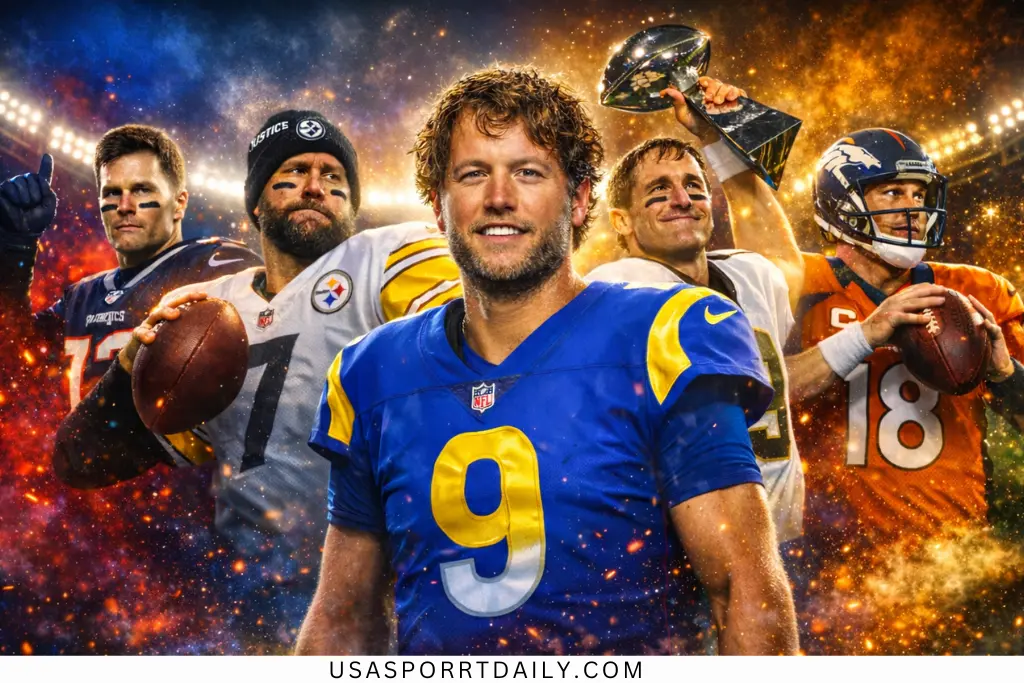
1. Tom Brady — 58 Game-Winning Drives
Tom Brady sits at the top of the list with an incredible 58 game-winning drives, cementing his reputation as the most clutch quarterback in NFL history.
Brady’s ability to remain calm in high-pressure situations became a hallmark of his career. Whether it was leading the New England Patriots to multiple Super Bowl victories or orchestrating last-minute comebacks with the Tampa Bay Buccaneers, Brady consistently delivered when it mattered most.
Some reasons Brady dominates this category include:
- Exceptional game awareness
- Elite decision-making under pressure
- Long career with consistent playoff and regular-season success
His legendary 28–3 comeback in Super Bowl LI is widely considered the greatest clutch performance in football history.
2. Peyton Manning — 54 Game-Winning Drives
Peyton Manning ranks second with 54 game-winning drives, proving that his football intelligence translated directly into late-game success.
Manning was known for his unmatched ability to read defenses at the line of scrimmage. His pre-snap adjustments and strategic play-calling often allowed him to exploit defenses during crucial final drives.
Throughout his career with the Indianapolis Colts and Denver Broncos, Manning showed that preparation and strategy could be just as powerful as raw athletic talent.
Key strengths that fueled Manning’s clutch drives:
- Elite football IQ
- Precise timing with receivers
- Mastery of offensive adjustments
3. Drew Brees — 53 Game-Winning Drives
Drew Brees, one of the most accurate passers in NFL history, recorded 53 game-winning drives during his career with the New Orleans Saints and San Diego Chargers.
Brees thrived in high-pressure situations because of his quick release and exceptional accuracy. His ability to methodically move the ball downfield made him a nightmare for defenses during late-game situations.
Despite often playing on teams that required him to carry the offense, Brees consistently delivered clutch drives throughout his career.
His late-game success was built on:
- Precision passing
- Quick decision-making
- Strong chemistry with receivers
4. Ben Roethlisberger — 53 Game-Winning Drives
Ben Roethlisberger shares the third spot with 53 game-winning drives, reflecting his reputation as one of the toughest quarterbacks of his generation.
Nicknamed “Big Ben,” Roethlisberger was famous for extending plays and delivering deep throws in critical moments. His physical strength and improvisational style made him especially dangerous late in games.
Playing for the Pittsburgh Steelers, Roethlisberger engineered numerous dramatic finishes that helped the franchise secure multiple playoff runs and Super Bowl victories.
5. Matthew Stafford — 50 Game-Winning Drives
Matthew Stafford has built a reputation as one of the most underrated clutch quarterbacks in the NFL, with 50 game-winning drives.
During his time with the Detroit Lions, Stafford often carried the offense and frequently found himself in comeback situations. His ability to throw deep passes and remain aggressive late in games helped him rack up an impressive number of game-winning drives.
His Super Bowl victory with the Los Angeles Rams further demonstrated his ability to deliver in critical moments.
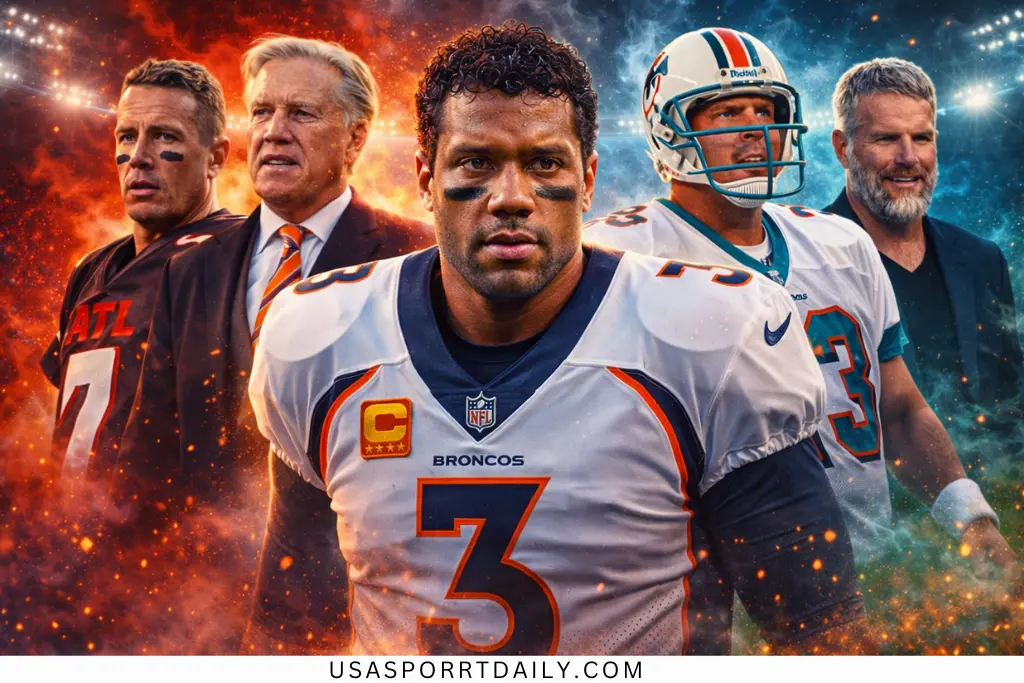
6. Dan Marino — 47 Game-Winning Drives
Dan Marino, one of the most prolific passers of the 1980s and 1990s, recorded 47 game-winning drives.
Marino revolutionized the passing game with his lightning-fast release and deep-ball accuracy. While he never won a Super Bowl, his late-game performances kept the Miami Dolphins competitive for years.
Marino’s ability to move the ball quickly downfield made him particularly dangerous during two-minute drills.
7. Matt Ryan — 46 Game-Winning Drives
Matt Ryan ranks next with 46 game-winning drives, highlighting his steady leadership throughout his NFL career.
Ryan’s calm demeanor and ability to execute structured offensive systems allowed him to engineer many late-game victories for the Atlanta Falcons.
His MVP season in 2016 showcased his peak performance and his ability to lead explosive offensive drives when needed.
8. Brett Favre — 43 Game-Winning Drives
Brett Favre finished his career with 43 game-winning drives, combining gunslinger mentality with fearless playmaking.
Favre was known for taking risks and pushing the ball downfield. While his aggressive style sometimes led to turnovers, it also produced dramatic game-winning moments that thrilled fans.
His durability and long career with the Green Bay Packers helped him accumulate a significant number of clutch victories.
9. John Elway — 40 Game-Winning Drives
John Elway’s career included 40 game-winning drives, many of which became iconic moments in NFL history.
Elway was famous for his dramatic fourth-quarter comebacks, including “The Drive” in the 1986 AFC Championship Game. His strong arm and mobility allowed him to keep plays alive and lead Denver to multiple Super Bowl appearances.
10. Russell Wilson — 40 Game-Winning Drives
Russell Wilson also holds 40 game-winning drives, demonstrating his ability to perform in clutch situations throughout his career.
Wilson’s mobility, deep-ball accuracy, and improvisational ability make him particularly dangerous in late-game scenarios. His calm presence and leadership have helped him engineer numerous comeback victories.
Why Game-Winning Drives Matter in Evaluating Quarterbacks
While statistics like passing yards and touchdowns measure productivity, game-winning drives measure impact.
A quarterback might throw for 400 yards, but if they can’t deliver in the final minutes, their performance may feel incomplete.
Game-winning drives highlight several critical quarterback traits:
- Leadership when the team needs confidence
- Decision-making under extreme pressure
- Composure during the two-minute drill
- Execution in high-stakes situations
These qualities separate good quarterbacks from legendary ones.
The Evolution of Clutch Quarterback Play in NFL History
Early NFL Era vs Modern Passing Era
Clutch quarterback play has changed a lot over the history of the NFL. In the early years of the league, especially between the 1930s and 1970s, football was mainly a running game.
Teams depended heavily on running backs and strong defenses to win games. Quarterbacks were important, but their main role was to manage the offense and avoid mistakes rather than make risky plays.
In late-game situations, coaches usually preferred safe strategies like running the ball and trying to get into field-goal range. Because of this, quarterbacks had fewer chances to lead exciting comeback drives.
The modern NFL looks very different. Since the 1990s, the game has become much more focused on passing.
Quarterbacks are now the center of the offense and are expected to lead their teams when the pressure is highest.
In close games, especially during the final minutes, teams often rely on their quarterback to move the ball quickly through the air. Fans today are used to seeing last-minute drives and dramatic finishes, something that was less common in the early years of the league.
Impact of Rule Changes Favoring Passing Offenses
Rule changes have played a big role in making quarterbacks more important in clutch moments.
One of the most important changes happened in 1978 when the NFL limited how much defenders could contact wide receivers after five yards from the line of scrimmage. This made it easier for receivers to run their routes and helped quarterbacks complete more passes.
Over time, the league also introduced stricter rules to protect quarterbacks from dangerous hits. Penalties for roughing the passer and hits to the head or knees became more serious.
These rules made passing safer and encouraged teams to throw the ball more often. Because of these changes, quarterbacks now have more opportunities to lead late-game drives and create memorable game-winning moments.
How Offensive Schemes Changed Late-Game Strategy
Offensive strategies have also evolved, especially in how teams handle the final minutes of a game. In earlier decades, teams often focused on running the ball and controlling the clock to avoid turnovers. Passing was seen as risky, so coaches were usually more cautious.
Today’s offenses are designed to move the ball quickly. Many teams use spread formations, shotgun snaps, and short passing plays to gain yards faster. In late-game situations, teams often run hurry-up or no-huddle offenses so they can save time and keep the defense from adjusting.
Because of these modern strategies, quarterbacks now have a much bigger role in deciding close games. They must stay calm, read the defense quickly, and make smart decisions under pressure. These skills are what truly define a clutch quarterback in today’s NFL.
Traits of the Most Clutch NFL Quarterbacks
Quarterbacks who consistently deliver game-winning drives often share several common traits.
Elite Decision-Making
Clutch quarterbacks rarely panic. They quickly read defensive coverages and make smart, efficient throws.
Strong Two-Minute Drill Skills
Late-game drives often require rapid plays and minimal mistakes. Elite quarterbacks master the two-minute offense.
Mental Toughness
Crowd noise, defensive pressure, and the weight of the moment can overwhelm many players. Great quarterbacks remain calm and focused.
Leadership
The best quarterbacks inspire confidence across the entire offense, helping teammates perform at their best during crucial drives.
How Modern NFL Offenses Affect Game-Winning Drives
The NFL has evolved into a pass-heavy league, which naturally increases opportunities for late-game comebacks.
Several factors contribute to the rise of game-winning drives:
- Rule changes favoring offensive players
- Faster offensive tempo
- Improved passing schemes
- Advanced quarterback training and analytics
As a result, modern quarterbacks may continue to climb the game-winning drive leaderboard in the future.
Conclusion: The Ultimate Measure of Clutch Greatness
Game-winning drives capture the essence of what makes football exciting: the tension, the pressure, and the heroics of players rising to the moment.
From Tom Brady’s record-setting 58 drives to Russell Wilson’s clutch performances, these quarterbacks proved that greatness is often defined by what happens in the final minutes.
While many quarterbacks can accumulate impressive statistics, only a select few consistently deliver when victory hangs in the balance. That ability—to lead a team down the field with the game on the line—is what transforms talented players into NFL legends.
As the league continues to evolve, new quarterbacks will attempt to join this elite list. But for now, these names represent the pinnacle of clutch performance in NFL history.
Frequently Asked Questions (FAQs)
Who has the most game-winning drives in NFL history?
Tom Brady holds the record for the most game-winning drives in NFL history with 58.
What counts as a game-winning drive?
A game-winning drive occurs when a quarterback leads an offensive drive in the fourth quarter or overtime that results in the go-ahead score for the final time.
Are game-winning drives the same as fourth-quarter comebacks?
No. A fourth-quarter comeback requires a team to be trailing before the drive begins, while a game-winning drive simply needs to produce the final winning score.
Which active NFL quarterback has the most game-winning drives?
Among active quarterbacks, Matthew Stafford and Russell Wilson rank among the leaders in game-winning drives.
Why are game-winning drives important?
Game-winning drives highlight a quarterback’s ability to perform under pressure, lead the offense, and deliver victories in critical moments.
Do playoff games count toward game-winning drives?
Yes, both regular-season and playoff games can count toward official game-winning drive statistics.
Can a field goal count as a game-winning drive?
Yes. If a field goal gives the team the lead for the final time in the fourth quarter or overtime, it counts as a game-winning drive.
Which quarterback is considered the most clutch in NFL history?
Tom Brady is widely considered the most clutch quarterback due to his record number of game-winning drives and multiple Super Bowl comebacks.